
The wealth management industry is experiencing one of its biggest transformations in decades. Artificial Intelligence (AI) is no longer just a futuristic concept-it has become a powerful financial tool that helps investors make smarter decisions, reduce risks, personalize portfolios, and improve long-term wealth creation.
From robo-advisors managing billions of dollars to AI-powered portfolio analytics and predictive market insights, technology is changing how individuals and institutions build wealth. However, despite rapid advancements, the human element remains essential. The future belongs to a hybrid model where AI enhances financial advisors rather than replacing them.
Recent industry developments also show that major financial institutions are integrating AI directly into wealth management platforms, enabling faster analysis, better personalization, and improved client experiences. At the same time, leading firms continue to emphasize that trust, judgment, and relationship management remain uniquely human strengths.
The Evolution of Wealth Management
Traditional wealth management relied heavily on financial advisors who manually analyzed portfolios, researched markets, and developed investment plans.
Today’s AI-driven wealth management combines:
- Machine learning
- Big data analytics
- Predictive modeling
- Natural language processing
- Real-time market intelligence
- Automated portfolio rebalancing
Instead of waiting days for portfolio reviews, investors can now receive personalized recommendations in seconds.
Global AI Adoption in Wealth Management
| Traditional Wealth Management | AI-Powered Wealth Management |
|---|---|
| Periodic portfolio reviews | Real-time portfolio monitoring |
| Manual market research | AI-driven market analysis |
| Generic investment advice | Personalized recommendations |
| Human-only financial planning | Human + AI collaboration |
| Delayed risk assessment | Continuous risk monitoring |
| Paper-based documentation | Digital automation |
Why AI Matters More Than Ever
Financial markets generate enormous volumes of data every second.
These include:
- Stock prices
- Economic reports
- Company earnings
- Global news
- Interest rates
- Social media sentiment
- Alternative datasets
No human advisor can process millions of data points instantly.
AI can.
Machine learning algorithms detect trends, recognize patterns, and identify investment opportunities before they become obvious.
This allows investors to make faster and more informed decisions.
Key Benefits of AI in Wealth Management
1. Personalized Investment Advice
Modern AI systems analyze:
- Income
- Age
- Risk tolerance
- Spending habits
- Financial goals
- Investment history
Instead of offering generic portfolios, AI creates customized investment strategies unique to each investor.
2. Better Risk Management
AI continuously monitors:
- Market volatility
- Portfolio diversification
- Sector exposure
- Currency risks
- Inflation trends
When risks increase, portfolios can be automatically adjusted before significant losses occur.
3. Predictive Analytics
AI studies historical patterns alongside current market conditions to forecast possible outcomes.
Although predictions are never guaranteed, they help investors prepare for multiple scenarios rather than reacting after markets move.
4. Automated Portfolio Rebalancing
Previously, advisors manually rebalanced portfolios every few months.
Today, AI can:
- Detect allocation drift
- Rebalance automatically
- Minimize tax impact
- Maintain target asset allocation
This keeps investments aligned with long-term goals.
AI Is Making Wealth Management More Accessible
One of AI’s greatest contributions is democratization.
Previously, professional wealth management was available mainly to high-net-worth individuals.
Now, AI-powered investment platforms offer sophisticated financial planning to everyday investors at significantly lower costs.
This has expanded access to financial advice for millions of people worldwide.
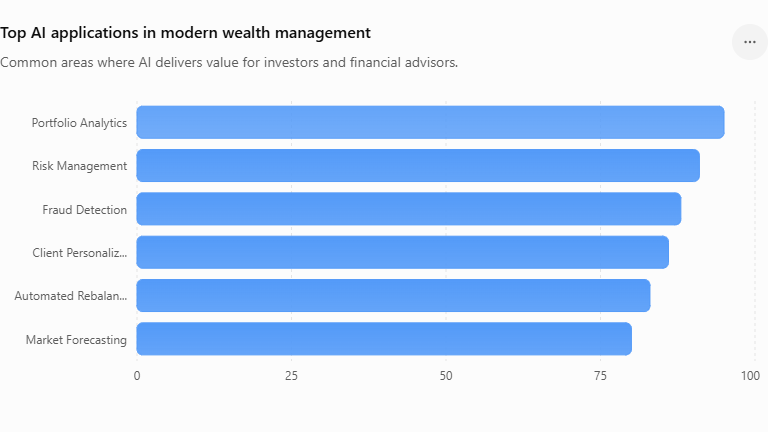
Investment Priorities in the AI Era
Top AI applications in modern wealth management
Common areas where AI delivers value for investors and financial advisors.
The Rise of Generative AI
Generative AI has become a game changer for wealth advisors.
Instead of spending hours preparing reports, advisors can now use AI to:
- Summarize portfolios
- Generate investment reports
- Compare financial products
- Analyze earnings reports
- Explain market movements
- Prepare client presentations
This allows advisors to spend more time building relationships and less time on administrative work.
Industry leaders increasingly view AI as a productivity partner rather than a replacement for financial professionals.
AI-Powered Fraud Detection
Cybercrime continues to grow alongside digital finance.
AI now protects investors by detecting:
- Unusual transactions
- Identity theft
- Suspicious login behavior
- Money laundering patterns
- Payment fraud
Machine learning systems continuously improve as they learn from new threats, making financial security stronger over time.
The Human Advisor Is Still Essential
Despite AI’s impressive capabilities, wealth management remains deeply personal.
Clients still value:
- Trust
- Emotional intelligence
- Life planning
- Family wealth discussions
- Retirement decisions
- Estate planning
- Tax strategies
These conversations require empathy and judgment that AI cannot fully replicate.
The future is not AI versus advisors.
It is AI working alongside advisors.
Challenges That Still Exist
AI is powerful, but it is not without limitations.
Data Privacy
Financial information is highly sensitive.
Institutions must ensure strong cybersecurity and compliance with evolving regulations.
Algorithm Bias
AI is only as good as the data it learns from.
Poor-quality data can produce biased recommendations.
Market Uncertainty
Unexpected geopolitical events, natural disasters, or economic crises cannot always be predicted accurately.
Human oversight remains essential.
Emerging Trends to Watch
Several trends are expected to shape wealth management over the coming years:
- Hyper-personalized investment portfolios
- AI-powered retirement planning
- Predictive tax optimization
- Voice-enabled financial assistants
- Digital twins for financial planning
- AI-supported estate and succession planning
- Autonomous portfolio monitoring
Financial institutions are also investing heavily in AI infrastructure and expanding AI capabilities across advisory services, signaling that intelligent automation will become a standard part of wealth management.
Industry Snapshot
| Metric | Latest Insight |
|---|---|
| AI investment funds | Global AI-focused fund inflows rose sharply in early 2026, with assets reaching record levels amid strong investor demand. |
| Advisor expectations | Wealth management firms increasingly position AI as a tool that augments—not replaces—human advisors. |
| Client behavior | Nearly half of affluent clients are considering moving a significant portion of their assets, reflecting rising expectations for personalized, technology-enabled advice. |
| AI infrastructure | Analysts estimate trillions of dollars will be invested globally in AI infrastructure between 2026 and 2031, accelerating adoption across financial services. |
Looking Ahead
Artificial Intelligence is fundamentally reshaping wealth management by making financial advice faster, smarter, and more personalized. Investors now have access to sophisticated analytics, automated portfolio management, real-time risk monitoring, and intelligent decision-support tools that were once available only to large institutions.
Yet, technology alone does not build lasting wealth. Financial success still depends on clear goals, disciplined investing, sound risk management, and trusted human guidance. AI can analyze millions of data points in seconds, but it cannot fully understand the personal aspirations, family dynamics, or life events that influence financial decisions.
The future of wealth management lies in combining intelligent technology with experienced advisors. Organizations that successfully integrate AI while preserving transparency, trust, and human judgment will be best positioned to serve the next generation of investors.
In the AI era, wealth management is no longer just about managing money—it is about using intelligent technology to make better financial decisions, strengthen long-term resilience, and create sustainable prosperity in an increasingly complex world.