
The hospitality industry has always been built on one promise—making guests feel welcome. In 2026, that promise is being enhanced by Artificial Intelligence (AI). Hotels, resorts, restaurants, and travel businesses are no longer using AI as a futuristic experiment; they are integrating it into daily operations to improve guest satisfaction, increase efficiency, reduce costs, and deliver highly personalized experiences.
Unlike previous waves of digital transformation, AI is not replacing hospitality—it is empowering it. The industry’s biggest challenge has always been balancing exceptional customer service with operational efficiency. AI is helping businesses achieve both simultaneously.
Industry experts estimate that AI adoption in hospitality is accelerating rapidly, with hotels increasingly investing in intelligent automation, predictive analytics, dynamic pricing, smart room technology, and AI-powered customer engagement. According to recent industry research, nearly 90% of travel companies are already experimenting with Generative AI, while 49% of hotel technology leaders have identified AI integration as a top technology priority.
Hospitality’s AI Revolution at a Glance
| Technology | Primary Benefit |
|---|---|
| AI Chatbots | 24/7 guest assistance |
| Dynamic Pricing | Higher occupancy & revenue |
| Predictive Maintenance | Reduced equipment failures |
| Smart Rooms | Personalized guest comfort |
| AI Housekeeping | Efficient workforce scheduling |
| Voice Assistants | Contactless guest experience |
| Predictive Analytics | Better business decisions |
Hospitality AI Adoption Trends
Top AI priorities among hotels in 2026
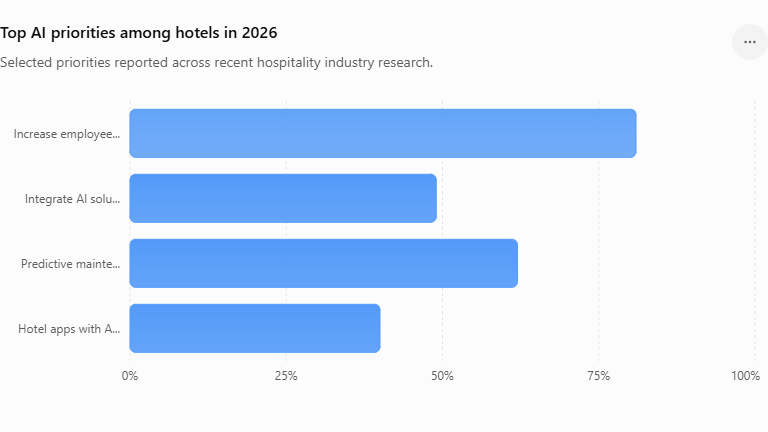
Figures are compiled from recent hospitality industry reports and technology surveys.
Personalized Experiences Become the New Standard
Today’s travelers expect much more than a clean room and comfortable bed. They expect hotels to understand their preferences before they even arrive.
AI systems now analyze booking history, loyalty memberships, travel behavior, dining preferences, previous complaints, and guest feedback to create highly personalized stays.
Imagine arriving at a hotel where:
- Your preferred room temperature is already set.
- Your favorite pillow type is waiting.
- Restaurant recommendations match your dietary preferences.
- Your check-in process takes less than one minute.
- The hotel suggests local experiences based on your previous vacations.
This level of personalization creates memorable experiences while increasing customer loyalty.
Industry research indicates that travelers increasingly expect personalized digital experiences, making AI-driven guest engagement a competitive necessity rather than a luxury.
AI-Powered Revenue Management
Revenue management has become one of AI’s most valuable applications.
Instead of manually adjusting room prices, AI analyzes thousands of variables simultaneously, including:
- Local events
- Weather forecasts
- Flight bookings
- Competitor pricing
- Historical occupancy
- Seasonal demand
- Booking patterns
- Cancellation trends
The result is dynamic pricing that maximizes occupancy while improving profitability.
Some hotel technology providers report 7–10% improvements in Revenue per Available Room (RevPAR) after implementing AI-based revenue management systems.
Smarter Operations Behind the Scenes
Guests rarely see what happens behind hotel operations.
AI is transforming these invisible processes through:
- Automated staff scheduling
- Smart inventory management
- Energy optimization
- Predictive maintenance
- Intelligent housekeeping assignments
Instead of cleaning rooms in a fixed order, AI identifies which rooms should be serviced first based on check-out times, guest arrivals, maintenance requests, and housekeeping availability.
Some hotels using AI-powered workforce scheduling have reported labor cost reductions of around 12% over several months.
Smart Rooms Are Becoming Intelligent Spaces
Hotel rooms in 2026 are increasingly connected through AI.
Guests can now control:
- Lighting
- Curtains
- Television
- Air conditioning
- Music
- Room service
- Wake-up schedules
using either their smartphones or voice assistants.
AI also learns guest preferences during the stay, automatically adjusting room settings without requiring manual input.
Smart energy management systems further reduce electricity consumption by detecting occupancy and optimizing lighting and climate control in real time.
AI Concierge Services
The traditional concierge desk is evolving into a hybrid model.
Modern AI concierges assist guests by:
- Recommending restaurants
- Booking taxis
- Planning sightseeing tours
- Translating languages
- Providing local travel advice
- Managing reservations
- Answering frequently asked questions
Unlike traditional support desks, AI assistants remain available 24 hours a day and respond instantly.
Human staff can therefore spend more time handling complex guest needs that require empathy and personal interaction.
Predictive Maintenance Prevents Guest Complaints
Nothing damages a guest experience faster than equipment failures.
AI-powered predictive maintenance continuously monitors:
- HVAC systems
- Elevators
- Plumbing
- Refrigeration
- Kitchen equipment
- Electrical systems
Instead of waiting for something to fail, AI predicts when maintenance should occur.
Recent surveys show 62% of hospitality IT leaders are investing in AI-driven predictive maintenance to improve reliability and reduce unexpected downtime.
Key AI Benefits Across Hospitality
📈 Revenue
- Dynamic pricing
- Upselling opportunities
- Improved occupancy
😊 Guest Experience
- Personalized recommendations
- Faster service
- 24/7 support
⚙️ Operations
- Workforce optimization
- Inventory automation
- Predictive maintenance
🌱 Sustainability
- Energy savings
- Reduced food waste
- Smart resource allocation
Human Hospitality Still Matters
Despite AI’s rapid growth, hospitality remains a people-centered industry.
Guests still value:
- Genuine smiles
- Emotional understanding
- Personalized conversations
- Problem-solving
- Cultural warmth
AI excels at handling repetitive tasks, analyzing data, and providing instant information. Human employees excel at empathy, creativity, and building meaningful relationships.
Industry leaders increasingly view AI as a tool that removes administrative burdens from staff, allowing them to focus on delivering exceptional guest experiences.
Challenges Hotels Must Address
AI adoption also introduces new responsibilities.
Hotels must ensure:
- Strong cybersecurity
- Guest data privacy
- Ethical AI usage
- Transparent decision-making
- Staff training
- Human oversight
Over-reliance on automation can reduce the warmth that defines great hospitality. The most successful hotels are therefore combining AI efficiency with authentic human service rather than replacing employees entirely.
Looking Ahead
The next phase of hospitality will likely be driven by Agentic AI—AI systems capable of completing multi-step tasks on behalf of guests and staff. Instead of simply answering questions, these systems may coordinate travel itineraries, adjust bookings in response to disruptions, manage loyalty benefits, and proactively resolve service issues. Industry research suggests that while experimentation with generative AI is already widespread, the coming years will focus on scaling these capabilities across entire hotel operations.
Final Thoughts
AI-powered hospitality in 2026 is no longer about replacing people—it is about enabling better service. From intelligent pricing and predictive maintenance to personalized stays and smart rooms, AI is helping hotels operate more efficiently while creating experiences that feel seamless and tailored to each guest.
The hotels that will lead the industry are not those with the most advanced technology alone, but those that combine intelligent automation with genuine human care. In the future of hospitality, technology will handle the routine, while people continue to create the moments guests remember most.