
The financial services industry has become one of the most targeted sectors for cybercriminals. As banks, insurance companies, investment firms, and fintech organizations continue to embrace digital transformation, they also face increasingly sophisticated cyber threats. From ransomware attacks and phishing scams to data breaches and AI-powered fraud, cybersecurity has become a top priority for every financial institution.
According to IBM’s Cost of a Data Breach Report 2024, the average global cost of a data breach reached $4.88 million, the highest ever recorded, while the financial sector remains among the industries with the highest breach-related costs. At the same time, cyberattacks on financial organizations continue to rise as criminals exploit digital banking, cloud infrastructure, and interconnected payment systems.
Cybersecurity is no longer just an IT concern—it is a business imperative that protects customer trust, financial stability, and regulatory compliance.
Why Financial Services Are Prime Targets
Financial institutions store highly valuable information, including:
- Customer identities
- Bank account details
- Credit card information
- Investment portfolios
- Loan records
- Insurance data
- Payment credentials
Unlike many other industries, stolen financial data can often be monetized immediately, making banks and financial institutions attractive targets for cybercriminals.
In addition, the rapid growth of digital banking, mobile payments, cryptocurrencies, and open banking has expanded the number of potential entry points for attackers.
The Growing Cyber Threat Landscape
Cyber threats continue to evolve in both scale and complexity.
Modern attackers now use:
- Artificial Intelligence
- Automation
- Deepfake technology
- Credential theft
- Social engineering
- Supply chain attacks
- Cloud exploitation
Financial institutions must defend against thousands of attack attempts every day while ensuring uninterrupted services for millions of customers.
Most Common Cybersecurity Threats
| Threat | Impact on Financial Institutions |
|---|---|
| Phishing Attacks | Stolen customer credentials and account access |
| Ransomware | Operational disruption and financial losses |
| Insider Threats | Data leaks and unauthorized access |
| Distributed Denial-of-Service (DDoS) | Online banking service outages |
| Identity Theft | Fraudulent transactions and account takeovers |
| AI-Powered Fraud | More convincing scams and phishing campaigns |
| Third-Party Vendor Risks | Compromised supply chains and shared systems |
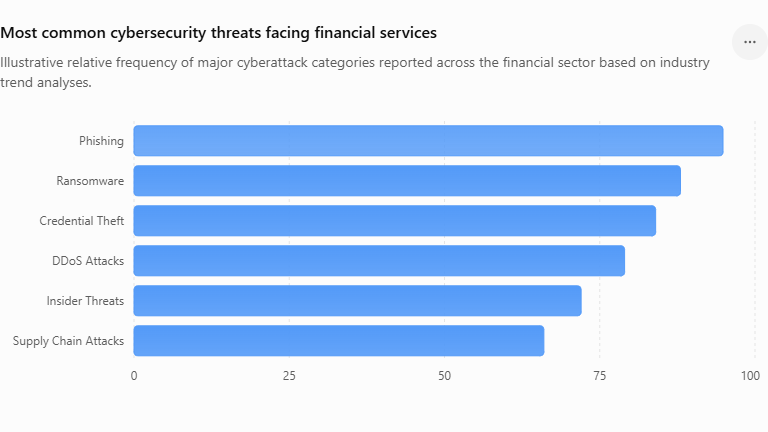
Global Financial Cyber Incidents by Type
Most common cybersecurity threats facing financial services
Illustrative relative frequency of major cyberattack categories reported across the financial sector based on industry trend analyses.
The Rise of AI-Powered Cybercrime
Artificial Intelligence is transforming cybersecurity—but it is also helping cybercriminals.
Attackers now use AI to:
- Generate highly personalized phishing emails
- Create realistic deepfake voices
- Automate malware deployment
- Identify software vulnerabilities faster
- Bypass traditional security filters
- Launch attacks at greater scale
As AI capabilities improve, financial institutions must adopt AI-powered security systems capable of detecting threats in real time.
Ransomware Remains a Major Threat
Ransomware attacks have become one of the most disruptive cybersecurity risks for financial organizations.
In these attacks, hackers encrypt critical systems and demand payment to restore access.
Consequences include:
- Service outages
- Lost customer confidence
- Regulatory investigations
- Financial penalties
- Recovery costs
- Business interruption
Even organizations that refuse to pay the ransom often face weeks of operational recovery.
Cloud Security Challenges
Cloud adoption has enabled financial institutions to improve scalability and reduce infrastructure costs.
However, cloud environments introduce new risks:
- Misconfigured cloud storage
- Weak access controls
- Shared responsibility misunderstandings
- API vulnerabilities
- Insider misuse
- Data exposure
Financial organizations must continuously monitor cloud environments while maintaining compliance with strict regulatory standards.
Protecting Customer Identity
Identity theft continues to be one of the fastest-growing cybercrimes.
Financial institutions now rely on advanced technologies such as:
- Multi-factor authentication (MFA)
- Biometric verification
- Behavioral analytics
- Device recognition
- Risk-based authentication
These measures significantly reduce the likelihood of unauthorized account access.
Regulatory Compliance Is Becoming More Demanding
Governments and regulators worldwide are strengthening cybersecurity requirements for financial institutions.
Organizations are expected to demonstrate:
- Strong encryption
- Regular security assessments
- Incident response planning
- Data protection measures
- Continuous monitoring
- Third-party risk management
- Employee cybersecurity training
Failure to comply can result in heavy financial penalties and reputational damage.
Human Error Remains the Weakest Link
Despite significant investments in cybersecurity technology, many successful attacks still begin with human error.
Common mistakes include:
- Clicking phishing links
- Reusing passwords
- Sharing sensitive information
- Falling for social engineering
- Using unsecured devices
- Ignoring software updates
Regular employee awareness training remains one of the most effective defenses against cyber threats.
Emerging Technologies Strengthening Cybersecurity
Financial institutions are investing in innovative security solutions, including:
Zero Trust Architecture
Rather than automatically trusting users inside a network, Zero Trust continuously verifies identities and devices before granting access.
AI-Powered Threat Detection
Machine learning systems analyze billions of network events to detect suspicious activity almost instantly.
Behavioral Analytics
Security platforms establish normal user behavior and flag unusual activity, such as unexpected login locations or abnormal transaction patterns.
Quantum-Resistant Cryptography
As quantum computing advances, organizations are preparing new encryption methods designed to withstand future computational capabilities.
Cybersecurity Investment Is Increasing
Financial institutions are significantly expanding cybersecurity budgets as digital threats continue to grow.
Industry priorities include:
- Security Operations Centers (SOCs)
- Cloud security platforms
- Identity and access management
- AI-driven monitoring
- Endpoint protection
- Security automation
- Threat intelligence platforms
Organizations increasingly recognize cybersecurity as a strategic investment rather than simply an operational expense.
Cybersecurity by the Numbers
| Metric | Latest Insight |
|---|---|
| Average global cost of a data breach | US$4.88 million in 2024, the highest on record (IBM Cost of a Data Breach Report 2024). |
| Financial sector risk | Financial services consistently rank among the industries facing the highest cyberattack frequency and breach costs. |
| Phishing impact | Phishing and stolen credentials remain among the leading initial attack vectors across financial organizations. |
| AI adoption | Financial institutions are rapidly deploying AI-powered security platforms to improve threat detection, fraud prevention, and automated incident response. |
Best Practices for Financial Institutions
To strengthen cyber resilience, organizations should focus on:
- Implementing Zero Trust security frameworks
- Conducting regular penetration testing
- Encrypting sensitive customer data
- Strengthening identity verification
- Monitoring third-party vendors
- Automating threat detection
- Providing continuous employee training
- Maintaining comprehensive incident response plans
- Backing up critical systems regularly
- Investing in cyber resilience rather than reactive security
Looking Ahead
The future of financial services will be increasingly digital, connected, and data-driven. While innovation is creating better customer experiences and more efficient operations, it is also expanding the cyber threat landscape. Financial institutions must prepare for a future where cyberattacks are more frequent, more sophisticated, and increasingly powered by artificial intelligence.
Cybersecurity can no longer be viewed as a defensive function alone. It has become a strategic capability that enables business growth, protects customer confidence, and supports regulatory compliance. Organizations that invest in advanced security technologies, robust governance, continuous employee education, and proactive risk management will be better equipped to navigate emerging threats.
Ultimately, trust remains the foundation of financial services. In an era where every transaction, investment, and customer interaction depends on digital systems, strong cybersecurity is essential not only for protecting assets but also for safeguarding the confidence that underpins the global financial ecosystem.